

What Does It Cost to Study in Germany? (Updated for 2025)
Germany has steadily emerged as one of the most attractive study-abroad destinations for Indian students—and the reasons are compelling. With globally recognized universities, cutting-edge research opportunities, and one of the most affordable higher education systems in the world, Germany offers exceptional value that stands out in today’s competitive landscape.
While tuition fees in countries like the USA, UK, and Australia continue to rise sharply, Germany presents a refreshing alternative: high-quality education at minimal or no tuition costs. For many Indian families, this means access to world-class degrees without the crushing burden of educational debt.
This updated guide for 2025 provides a detailed breakdown of the cost of studying in Germany, covering tuition fees, living expenses, visa requirements, scholarships, and practical tips to help students make informed financial decisions.
Germany’s Distinct Education Model
Germany treats higher education as a public good rather than a commercial product. This philosophy explains why most public universities in Germany charge either no tuition fees or only a nominal semester contribution. In practical terms, this makes studying in Germany almost like having a built-in scholarship for every student.
For Indian students, this model has been a game-changer, offering access to institutions ranked among the world’s best while keeping education affordable.

Tuition Fees in Germany: Public vs Private Universities
Public Universities – Affordable for All
At most public universities, international students—including Indians—pay no tuition fees. Instead, they contribute a semester fee ranging from €250–€350 (₹22,500–₹31,500), which covers student union membership, administrative costs, and often a public transportation pass valid across entire states.
The Baden-Württemberg Exception
One exception exists in Baden-Württemberg, where non-EU/EEA international students must pay €1,500 per semester (€3,000 per year). Prestigious institutions like the University of Stuttgart, Heidelberg University, and KIT fall under this policy. While this is higher than in other states, it remains far below tuition fees in the USA or UK.
Private Universities – Higher Costs, Specialized Programs
Private institutions charge between €10,000–€20,000 (₹9–18 lakhs) annually. These universities often focus on specialized programs in management, business, or applied sciences, with smaller class sizes and stronger industry connections. Popular names include ESMT Berlin and the Frankfurt School of Finance & Management.
Living Expenses in Germany for Indian Students
While tuition is minimal, living costs form the primary expense. On average, students spend around €842–€1,000 per month (₹75,000–₹89,000), depending on lifestyle and location.
Typical Monthly Breakdown:
- Accommodation: €300–€700 (dorms are cheapest; Munich is most expensive)
- Food & Groceries: €200–€300 (cooking at home saves costs; Indian groceries are widely available)
- Health Insurance: €80–€120 (mandatory for all students)
- Transportation: €60–€150 (often included in semester fee via public transport pass)
Personal Expenses: €100–€200 (internet, phone, books, leisure)
City-Specific Variations:
- High-cost cities: Munich (€1,200–€1,500/month), Frankfurt (€1,100–€1,400/month)
- Moderate-cost cities: Berlin (€900–€1,200/month), Dresden (€800–€1,000/month)
- Affordable options: Chemnitz or Magdeburg (€600–€850/month)
Visa & Financial Proof: Blocked Account Requirements
For a German student visa, applicants must show proof of funds in a blocked account. As of January 2025, the requirement is €11,904 (₹10.7 lakhs) for one year.
This amount ensures students have at least €992 per month to cover living expenses. Approved providers include Deutsche Bank, Expatrio, and Coracle, each offering slightly different fees and processes.

Scholarships in Germany for Indian Students
Germany offers a wide range of scholarships, making education even more accessible.
- DAAD Scholarships: Monthly stipends from €934–€1,200, plus allowances.
- Heinrich Böll, Konrad Adenauer & Friedrich Ebert Foundations: Focus on merit, leadership, and social engagement.
- Deutschlandstipendium: €300/month, jointly funded by the government and private sponsors.
- University-specific scholarships: TUM, RWTH Aachen, and Stuttgart offer merit-based and research-specific support.
Scholarship applications typically require strong academics, a clear Statement of Purpose (SOP), recommendation letters, and sometimes German language proficiency.
Part-Time Jobs & Work Opportunities
Germany permits students to work 120 full days or 240 half days per year, providing opportunities to offset costs.
Common roles for Indian students include:
- Research or teaching assistant (€12–€18/hr)
- Restaurant or delivery jobs (€9–€15/hr)
- Tutoring or IT support (€15–€30/hr)
Average monthly earnings range from €400–€900, with students in specialized roles earning even more.
Cost Comparison: Germany vs Other Countries
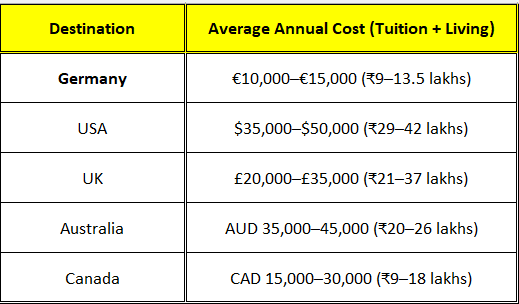
Clearly, Germany remains one of the most cost-effective study abroad destinations, offering world-class education at a fraction of the cost.
Final Thoughts: Why Germany Makes Sense in 2025
For Indian students and parents worried about skyrocketing tuition abroad, Germany provides a rare blend of affordability, academic excellence, and career opportunities. With nearly tuition-free education, reasonable living costs, multiple scholarships, and strong post-study work options, studying in Germany is not just a smart financial decision—it’s a transformative life opportunity.
Plan early, prepare your finances, and explore scholarship opportunities to maximize your chances of success. Remember: in Germany, education isn’t just about cost savings; it’s about opening doors to a global career, international networks, and long-term personal growth.